Don't Let The Sun Go Down On Me...
Digging The Melt Tank

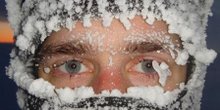
As April disappears, the encroaching darkness ushers May in. While the UK celebrated one of its warmest Aprils on record, we enjoyed, if that is the appropriate phrase, the coldest April ever recorded at Halley in the 50-odd years that there has been a research station here. With a mean temperature of -29.1°C, it was frequently below -40, the point at which the Fahrenheit and Celsius scales intersect.
The Sun Rising to its Zenith
Photos taken every 30mins on 22nd April

While the rising temperatures in the UK can be understood amidst concerns over global warming, it is predicted that any rise in global temperatures may lead to a paradoxical cooling at Halley. The concerns over climate change are supported by data collected by BAS and other scientists across the Antarctic peninsula (where the station at Rothera is situated), over the last 50 years, which has demonstrated a clear 2.5°C increase in temperatures, a rate 5 times faster than the global mean, with an associated loss of coastal ice and retreat of glaciers. Meanwhile at Halley, the collection of meteorological data as part of long term monitoring projects is one of the tasks of the Met Observing team on the Simpson platform.
Aurora Over the Simpson

There is one word that has almost the same effect as the fire alarm in rousing people and, unlike a fire alarm, clearing the platform into the cold, dark outdoors. Mainly uttered by the nightwatchman 'Aurora...!', usually preceded by a knock on the pit room door to waken the occupant, who has indicated he wishes to be woken should one occur, results in a rush-hour like squeeze in the boot room as people try to clothe themselves in order not to miss any part of the display. The outside safety light is doused and some take up positions on the platform, while others scuttle to the bottom of the stairs to enjoy a more uninterrupted horizon. The first out, however, are rarely the photographers, as they struggle to ensure that everything is set perfectly so that there is minimal handling of the cold metal bodies of the camera and tripod, which sap heat from exposed, fiddling fingers.
Aurora Over the Science Platforms
The aurora invariably appears in the southern sky centred towards the magnetic pole

Despite all the photographic preparations, as can be seen it is difficult to capture all the colours and movement associated with the appearance of an auroral display. Aurora, named after the Roman goddess of the dawn, aptly reflects the ability of the display at times to almost completely illuminate the sky as if the sun where returning, yet each appearance has a unique nature. The science dealt with by the Piggott platform concentrates on the nature of the upper atmosphere and sun-earth interactions. More of this another time but aurora are the most visible manifestation of some of the areas studied through work at Halley.
Renovating the Signpost

A fair bit of my spare time over the last month has been turned over to renovating the heavily photographed signpost. As with all things here, it needed digging out and raising from the advancing snow level, so it seemed an appropriate time to repaint some of the more battered areas, the sort of task that always takes longer than expected but it is back up again, with its obliterated destinations and distances now legible again.
The Union Flag Over The Laws

Despite being surrounded and living on fresh water, its frozen state means that its use remains at a premium. Water saving alterations have been made on every device and showering becomes an infrequent and cursory ritual, with the shower heads turned on as little as possible. That being said, we don't find ourselves deprived of water in the least, it merely makes one realise how profligate we are with it as a commodity in the UK.
Filling the Melt Tank at 9am
A weekly rota ensures a team of three keep the tank topped up

Water, unsurprisingly, is obtained by melting ice in a large melt tank, situated 35 metres under the ice in the Laws tunnel system. This requires a daily detail (regardless of the weather) of 3-4 people to dig and shovel snow into the long neck of the tank situated on the surface. This is made easier by weekly using a bulldozer to fashion a large volcano of ice around the tank opening. Starting a bulldozer at our current temperatures requires about three hours of pre-heating the engine (hence it cannot be used daily) and should it spend prolonged periods below -40° C/F then even the weekly fashioning of a mound of snow becomes impractical as the 'dozer will not start. Nonetheless it is still a good half an hours work on a good day and considerably longer if the gashman has done several loads of washing and the snow is heavily frozen.
Jim and Sune Next to the Melt Tank

There are two tunnel systems, one near the Piggott and the larger system that runs between the Laws and the Simpson. While the latter contains the main melt tank, both systems contain flubbers, large rubber fuel double walled bags filled with Avtur, to supply the generator sets on the respective platforms.
The Laws Flubbers
Avtur, unlike diesel, will not freeze at the temperatures in the tunnels

Tunnels as confined spaces, pose a hazard anywhere in the world, no less so here and with various people needing to work in them on a frequent basis, there is always a risk of injury. Therefore, before the darkness descended, we spent an afternoon running through a scenario involving rescuing an injured casualty on a stretcher using the various bits of specialist kit on station.
Tunnel Rescue Team
Including our headless dummy- photo by Tom Spieß

Thinking about how to remove a casualty from a confined space safely and learning to assemble stretchers and winching gear is one of the very different skills I have had to learn as a doctor down here. Things that may seem obvious such as stretchers, you rarely come across in hospitals but have become very familiar from pre-deployment training and teaching first-aiders while South.
Ascending the Fuel Shaft
The stretcher with dummy is winched out, while I follow, roped up for safety

The sun has finally disappeared, in a fashion that it has been threatening to do for several weeks, the exact date was a matter of great debate around the dinner table, as each science group uses slightly different definitions and calculations to ascertain 'sun-down'. Regardless, we celebrated its last appearance on the 2nd May with the lowering of the base flag.
1340Hrs 2nd May
The sun makes its last appearance for 14 week, though local time is GMT, the sun's zenith given our longitude occurs at 1340

Traditionally the base Union Flag is replaced at sun-up and flies over the base until sun-down, when it is lowered and 'retired' by being raffled off between the winterers. At times it appeared doubtful if this flag would make it all the way through to sun-down given the battering it receives from the wind. As such, Pete (Z-Base Commander), as the oldest member of base, with a short speech, lowered the tattered remains of the flag.
Pete Lowers the Base Flag
Photos courtesy of Ant Dubber

Never needing much of an excuse for a party, the evening disappeared into a barbecue and Hawaiian cocktail night. Sun-down also means the start of one of my research projects associated with the effect of the loss of light on the winterers.
Full Moon Over the Laws


As April disappears, the encroaching darkness ushers May in. While the UK celebrated one of its warmest Aprils on record, we enjoyed, if that is the appropriate phrase, the coldest April ever recorded at Halley in the 50-odd years that there has been a research station here. With a mean temperature of -29.1°C, it was frequently below -40, the point at which the Fahrenheit and Celsius scales intersect.
The Sun Rising to its Zenith
Photos taken every 30mins on 22nd April

While the rising temperatures in the UK can be understood amidst concerns over global warming, it is predicted that any rise in global temperatures may lead to a paradoxical cooling at Halley. The concerns over climate change are supported by data collected by BAS and other scientists across the Antarctic peninsula (where the station at Rothera is situated), over the last 50 years, which has demonstrated a clear 2.5°C increase in temperatures, a rate 5 times faster than the global mean, with an associated loss of coastal ice and retreat of glaciers. Meanwhile at Halley, the collection of meteorological data as part of long term monitoring projects is one of the tasks of the Met Observing team on the Simpson platform.
Aurora Over the Simpson

There is one word that has almost the same effect as the fire alarm in rousing people and, unlike a fire alarm, clearing the platform into the cold, dark outdoors. Mainly uttered by the nightwatchman 'Aurora...!', usually preceded by a knock on the pit room door to waken the occupant, who has indicated he wishes to be woken should one occur, results in a rush-hour like squeeze in the boot room as people try to clothe themselves in order not to miss any part of the display. The outside safety light is doused and some take up positions on the platform, while others scuttle to the bottom of the stairs to enjoy a more uninterrupted horizon. The first out, however, are rarely the photographers, as they struggle to ensure that everything is set perfectly so that there is minimal handling of the cold metal bodies of the camera and tripod, which sap heat from exposed, fiddling fingers.
Aurora Over the Science Platforms
The aurora invariably appears in the southern sky centred towards the magnetic pole

Despite all the photographic preparations, as can be seen it is difficult to capture all the colours and movement associated with the appearance of an auroral display. Aurora, named after the Roman goddess of the dawn, aptly reflects the ability of the display at times to almost completely illuminate the sky as if the sun where returning, yet each appearance has a unique nature. The science dealt with by the Piggott platform concentrates on the nature of the upper atmosphere and sun-earth interactions. More of this another time but aurora are the most visible manifestation of some of the areas studied through work at Halley.
Renovating the Signpost

A fair bit of my spare time over the last month has been turned over to renovating the heavily photographed signpost. As with all things here, it needed digging out and raising from the advancing snow level, so it seemed an appropriate time to repaint some of the more battered areas, the sort of task that always takes longer than expected but it is back up again, with its obliterated destinations and distances now legible again.
The Union Flag Over The Laws

Despite being surrounded and living on fresh water, its frozen state means that its use remains at a premium. Water saving alterations have been made on every device and showering becomes an infrequent and cursory ritual, with the shower heads turned on as little as possible. That being said, we don't find ourselves deprived of water in the least, it merely makes one realise how profligate we are with it as a commodity in the UK.
Filling the Melt Tank at 9am
A weekly rota ensures a team of three keep the tank topped up

Water, unsurprisingly, is obtained by melting ice in a large melt tank, situated 35 metres under the ice in the Laws tunnel system. This requires a daily detail (regardless of the weather) of 3-4 people to dig and shovel snow into the long neck of the tank situated on the surface. This is made easier by weekly using a bulldozer to fashion a large volcano of ice around the tank opening. Starting a bulldozer at our current temperatures requires about three hours of pre-heating the engine (hence it cannot be used daily) and should it spend prolonged periods below -40° C/F then even the weekly fashioning of a mound of snow becomes impractical as the 'dozer will not start. Nonetheless it is still a good half an hours work on a good day and considerably longer if the gashman has done several loads of washing and the snow is heavily frozen.
Jim and Sune Next to the Melt Tank

There are two tunnel systems, one near the Piggott and the larger system that runs between the Laws and the Simpson. While the latter contains the main melt tank, both systems contain flubbers, large rubber fuel double walled bags filled with Avtur, to supply the generator sets on the respective platforms.
The Laws Flubbers
Avtur, unlike diesel, will not freeze at the temperatures in the tunnels

Tunnels as confined spaces, pose a hazard anywhere in the world, no less so here and with various people needing to work in them on a frequent basis, there is always a risk of injury. Therefore, before the darkness descended, we spent an afternoon running through a scenario involving rescuing an injured casualty on a stretcher using the various bits of specialist kit on station.
Tunnel Rescue Team
Including our headless dummy- photo by Tom Spieß

Thinking about how to remove a casualty from a confined space safely and learning to assemble stretchers and winching gear is one of the very different skills I have had to learn as a doctor down here. Things that may seem obvious such as stretchers, you rarely come across in hospitals but have become very familiar from pre-deployment training and teaching first-aiders while South.
Ascending the Fuel Shaft
The stretcher with dummy is winched out, while I follow, roped up for safety

The sun has finally disappeared, in a fashion that it has been threatening to do for several weeks, the exact date was a matter of great debate around the dinner table, as each science group uses slightly different definitions and calculations to ascertain 'sun-down'. Regardless, we celebrated its last appearance on the 2nd May with the lowering of the base flag.
1340Hrs 2nd May
The sun makes its last appearance for 14 week, though local time is GMT, the sun's zenith given our longitude occurs at 1340

Traditionally the base Union Flag is replaced at sun-up and flies over the base until sun-down, when it is lowered and 'retired' by being raffled off between the winterers. At times it appeared doubtful if this flag would make it all the way through to sun-down given the battering it receives from the wind. As such, Pete (Z-Base Commander), as the oldest member of base, with a short speech, lowered the tattered remains of the flag.
Pete Lowers the Base Flag
Photos courtesy of Ant Dubber

Never needing much of an excuse for a party, the evening disappeared into a barbecue and Hawaiian cocktail night. Sun-down also means the start of one of my research projects associated with the effect of the loss of light on the winterers.
Full Moon Over the Laws