Sunday, June 10, 2007

Lightboxes and Circadian Rhythms

Looking Back Towards Base
From right to left: Laws, Piggott, BART caboose and Simpson platforms


The above view is taken from just below my favourite spot on base. The Laws platform lies at the centre of a large oval that describes the perimeter with a diameter of upto a couple of miles; it is this oval that effectively defines the extent of our world for most of the periods of darkness. Hence ski-ing, walking or even running (a sport reserved for super-fit Field Assistants), around the perimeter is an attempt to explore the very edges of this world and an important diversion from the necessary and mostly enjoyable proximity of the 17 other inhabitants of this isolated microcosm.

Aurora Over the Piggott


As one heads back towards the Laws from the Optical caboose (one of the science cabooses housing important new radar equipment), on the southern edge of the perimeter, the SHARE windtail- the mound of snow that accumulates behind any object on the snow surface- creates a rolling hill that shields the south from the bright lights that spill off the platforms. As you crest the brow of the windtail it feels as if it were a meadow with the bright lights of a village laid out below. This sense of delight is heightened by an absence of vehicles in the southern sector of the base at any time of the year (given the delicate science equipment), which means that the snow, bar the low-lying sastrugi, is a pleasure to ski across.

Drums
Moving fuel round base with a 'dozer


A majority of my work through the darkness is spent in running one of the biomedical science projects on base. Halley provides an ideal location for the study of the role of light in the regulation of human circadian rhythm. Circadian ('around a day') rhythms manifest themselves most obviously in our sleep-wake cycles, yet many other physiological and biochemical processes vary over this time frame. This rhythm is generated endogenously (that is from within ourselves) and probably by every cell in the body, though it is regulated from a part of the brain called the suprachiasmatic nucleus. If we were left in a dark room with minimal external stimuli we would revert to our own internal circadian rhythm. The exact length of the cycle, however, varies significantly between individuals; some people have an innate cycle length of 23.5 hours while some may be as long as 27 hours, though the majority lie at around 24.5 hours.

Aurora Over the Halley Signpost


Given that our body would prefer to work off a cycle that is not exactly 24 hours long, it is clear there needs to be a mechanism that resets (entrains) the internal clock so that it synchronises with the world around us. Light is one of the most important cues in this synchronising with the external world. Given the disappearance of the sun here, for 3 months of the winter, those wintering tend to develop problems associated with the inability to synchronise their internal clock with the 24 hour day, the most obvious being sleep disturbance.

Lightbox Exposure


Work over the previous 20 years here has had benefits not only for subsequent winterers, in modification of ambient lighting on the main platform but is also applicable to all environments where there are extended periods of low ambient light. However, as worldwide we move to living 24 hour days, it is in the understanding of shift work and the health problems associated with it, that the work at Halley has had a wider impact. If you want to read more then try this link to pages at the University of Surrey. For more in depth reading the following review is a good place to start: Arendt J. Melatonin, Circadian Rhythms and Sleep. New England Journal of Medicine 343: 1114-1116.

Die Feuerzangenbowle
Tom introduces us all to a German pre-Christmas tradition as we head towards the mid-winter celebrations


The emphasis of the study this year in brief, is to see whether an exposure to a high intensity bright light for an hour in the morning, improves sleep-wake cycles, activity and cognitive performance. The study runs over the period of sundown and is dependent upon the willing and enthusiastic participation of many of those on base. As sociable as it may seem sitting in a room together for an hour in front of bright lights, the whole hour seems to pass in polite silence in order not to disturb the sensibilities of some of those on base who are not at their best in the mornings.

Moving Rubbish off the Laws


When it comes to waste regardless of each operator's international obligations (the Antarctic Treaty obliges all of its signatories to remove nearly all the waste that they produce from the continent), there is a strong ethical case for doing so and minimising the effect that we have on this near-pristine environment. During the winter the base doctor at Halley traditionally takes responsibility for the waste management role that is important as part of keeping the base running; it is the same this year and takes on average a day a week of my time. It does not mean that I go round emptying every bin or sorting it but like a glorified Antarctic bin-man, I ensure it is correctly packaged, compressed and ready to ship out come the first call of the Shackleton.

Manhauling the Food Waste
(Thanks to Ant Dubber for the photo)


We send back to the UK and Falkland Islands a phenomenal amount of the waste that is produced here for recycling, from the everyday plastics and cardboard to waste oil and photo processing chemicals, there is very little either on the industrial or domestic side that cannot be recycled and as a result the sled on the outgoing cargo line part-filled with waste destined for landfill, is far outnumbered by those labelled for recycling.

Sune Overhauling Primus Stoves
Winter gives the opportunity to clean and maintain all the field kit before next season


Again, in a situation not dissimilar to our water use, it is an eye-opener to quite how profligate we are at home with our waste and how much could be recycled saving energy and raw materials, not so for Tom, our German colleague on, for him this is not unusual- reflecting quite how far we lag behind Germany in minimising the amount of rubbish we simply bury.

More Aurora
Demonstrating some of the more transient colours seen in the displays


The picture below illustrates nicely our standard outdoor kit around base for mild weather or when out digging- as in the melt tank in this case. Depending on how cold it is, people wear trousers or shorts and a t-shirt or warmer top underneath the ubiquitous padded boiler suit.

Dean Modelling at the Melt Tank


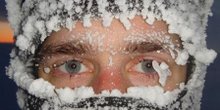
These orange all-in-ones start off the colour of the jacket in the photo but rapidly fade from daily wear and the harsh UV when the sun is around. The jackets, known as a 'windy', made from the same cotton Ventile material as the pyramid tents but thinner, are great windproof pieces of kit. On the feet, we wear mukluks, boots with a separate warm liner and given the industrial work around the place all have steel toe-caps. Goggles, hat, padded gloves and a 'neckie', a hoop-like piece of material that covers the face and neck completes the ensemble. As it gets colder (anything below -25), the priority is to ensure that all exposed skin is well covered to prevent it getting frostnipped (the early, reversible stage of frostbite).

The Laws Platform

Friday, May 25, 2007

The Sky By Night... & By Day

The Lunchtime Glow


The disappearance of the sun does not mean the complete absence of any light, the few hours around the middle of the day are illuminated by a faint glow to the North. That is, if there is not heavy cloud cover as has dominated the last fortnight including some significant winds. However, bad weather invariably means warmer temperatures as the albedo of the clouds, as well as their insulating effect means that heat is trapped close to the ice surface. As a result the temperature rockets up, rising to an uncomfortably sticky -5°C for part of a day.

The Laws During A Storm


The contrasting cold temperatures of April were a result of the persistent clear skies. Without clouds the high albedo of the snow surface means that a large proportion of radiant heat is reflected back into the atmosphere. Though I realise I write a lot about the weather, it reflects how it predominates all activity here and how dependent we are upon good weather for outside work.

The Moon Over The Piggott and SHARE
One of the half-buried Nansen field sledges waits to be put away


However, it hasn't been all bad weather and heavy cloud cover, when they disappear the pollution-free atmosphere (in terms of both light and exhaust fumes), means that the darkness both at night and in the day makes it a great place for astronomy.

Jupiter and The Milky Way
The Drewry, shuttered up for the winter, sits under an open sky


One recent night meant an opportunity to view unaided: a beautifully lit half moon, Jupiter, the Milky Way and an auroral display simultaneously. Fortunately, there is a small telescope and Tamsin, as the keenest (and most knowledgeable) astronomer on base had it out so we could all take in Jupiter and the spectacular detail on the moon's surface, we are fortunate to be able to complain that an auroral haze occasionally interfered.

Looking for Jupiter's Moons
Dean, Tamsin and Dave out with a telescope out during an auroral event


Auroral events occur about 50 miles or so above the earth's surface, where charged particles collide with with atoms present in the upper atmosphere. The green colour that predominates results from the collision with oxygen but there are occasionally other colours that relate both to oxygen and nitrogen, though they fail to persist as long. These charged particles emanate from the sun as solar wind, a stream of hot ionised gas emitted in all directions from the Sun's corona and by the magnetosphere, that area of space affected by the earth's magnetic field. The nature of the magnetic field means that these particles are drawn towards the poles, hence auroral events are rarely seen outside the polar regions.

SHARE Radar


The SHARE radar (Southern Hemisphere Auroral Radar Experiment), is a collaborative project with various radars across Antarctica, capturing information continuously about the earth's magnetosphere and ionosphere. Ours dominates the South side of the base sending out pules of radio frequency energy into the atmosphere over the continent south of here and as part of a worldwide network helps give information about space weather and particularly geomagnetic storms.

Aurora Over the SHARE


These storms, of which aurora can be the visible vanguard, result from strong solar winds buffeting the earth's magnetosphere and can be damaging to a large range of electromagnetic systems on earth but particularly to satellites and space missions. In strong storms, power supplies, communications and navigation systems can all be threatened prediction and better understanding of these storms allows steps to be taken to avoid these damaging effects.

Walking Back from the Piggott
The rope is a handline- essential for route-finding in a blow


Furthermore, from a BAS perspective these experiments also form part of a bigger program to understand whether the Sun's energy, in form of solar winds and high-energy radiations, effects the earth's climate and if it does, how it does so. On station, the team on the Piggott's (Chris, Jules and Alex), role is to keep these experiments running 24 hours a day, the data then heads back to Cambridge for analysis.

Tamsin's Birthday Cake
A cheese-free cheeseboard


Our satellite connection with to Cambridge also supports our communication with the outside world in the form of email and the internet. Recent additions to life down here (within the last two years), unimaginable when the first Halley was built and the ship called in but once a year.

The Radio Room
Dean in his lair


Since most of the communication is now over satellite and requires considerable computer support, the radio room may seem an anachronistic title but HF (high frequency) radio is still used to keep in contact with the field parties and planes in the summer, while everybody carries a VHF radio with them once they leave the main platform. Keeping all of this running, as well as acting as radio operator, is part of the Comms Manager's job on base, though Deano's more visible and trying daily job is the printing of an emailed newspaper with a relevant and appropriate witty local headline.

The HF Antennae Covered In Rime


Darkness does not preclude outside work particularly as a decent blow means that there is snow to be shifted before things disappear forever.

A Disappearing Field Skidoo


We are fortunate in some respects that we do not have any fuel depots to raise by hand this winter, previous year's winterers must think we have it easy but it does mean that generally people are keen for some outside work when the opportunity comes along. It is all too easy not to shift far from the main platform, a blessing in bad weather but the base is a beautiful place at this time of year and would be a shame not to witness it.

Digging Out Skidoos by the Garage


There are less than a thousand people on the continent at this time scattered across the various bases around the Antarctic and our nearest wintering neighbours at Neumayer (German base- 800km) and Belgrano (Argentinian base- 350km) could be on another planet given the difficulty that would be entailed in travelling to them at this time of year.

Moon Over The Laws

Sunday, May 06, 2007

Don't Let The Sun Go Down On Me...

Digging The Melt Tank


As April disappears, the encroaching darkness ushers May in. While the UK celebrated one of its warmest Aprils on record, we enjoyed, if that is the appropriate phrase, the coldest April ever recorded at Halley in the 50-odd years that there has been a research station here. With a mean temperature of -29.1°C, it was frequently below -40, the point at which the Fahrenheit and Celsius scales intersect.

The Sun Rising to its Zenith
Photos taken every 30mins on 22nd April


While the rising temperatures in the UK can be understood amidst concerns over global warming, it is predicted that any rise in global temperatures may lead to a paradoxical cooling at Halley. The concerns over climate change are supported by data collected by BAS and other scientists across the Antarctic peninsula (where the station at Rothera is situated), over the last 50 years, which has demonstrated a clear 2.5°C increase in temperatures, a rate 5 times faster than the global mean, with an associated loss of coastal ice and retreat of glaciers. Meanwhile at Halley, the collection of meteorological data as part of long term monitoring projects is one of the tasks of the Met Observing team on the Simpson platform.

Aurora Over the Simpson


There is one word that has almost the same effect as the fire alarm in rousing people and, unlike a fire alarm, clearing the platform into the cold, dark outdoors. Mainly uttered by the nightwatchman 'Aurora...!', usually preceded by a knock on the pit room door to waken the occupant, who has indicated he wishes to be woken should one occur, results in a rush-hour like squeeze in the boot room as people try to clothe themselves in order not to miss any part of the display. The outside safety light is doused and some take up positions on the platform, while others scuttle to the bottom of the stairs to enjoy a more uninterrupted horizon. The first out, however, are rarely the photographers, as they struggle to ensure that everything is set perfectly so that there is minimal handling of the cold metal bodies of the camera and tripod, which sap heat from exposed, fiddling fingers.

Aurora Over the Science Platforms
The aurora invariably appears in the southern sky centred towards the magnetic pole


Despite all the photographic preparations, as can be seen it is difficult to capture all the colours and movement associated with the appearance of an auroral display. Aurora, named after the Roman goddess of the dawn, aptly reflects the ability of the display at times to almost completely illuminate the sky as if the sun where returning, yet each appearance has a unique nature. The science dealt with by the Piggott platform concentrates on the nature of the upper atmosphere and sun-earth interactions. More of this another time but aurora are the most visible manifestation of some of the areas studied through work at Halley.

Renovating the Signpost


A fair bit of my spare time over the last month has been turned over to renovating the heavily photographed signpost. As with all things here, it needed digging out and raising from the advancing snow level, so it seemed an appropriate time to repaint some of the more battered areas, the sort of task that always takes longer than expected but it is back up again, with its obliterated destinations and distances now legible again.

The Union Flag Over The Laws


Despite being surrounded and living on fresh water, its frozen state means that its use remains at a premium. Water saving alterations have been made on every device and showering becomes an infrequent and cursory ritual, with the shower heads turned on as little as possible. That being said, we don't find ourselves deprived of water in the least, it merely makes one realise how profligate we are with it as a commodity in the UK.

Filling the Melt Tank at 9am
A weekly rota ensures a team of three keep the tank topped up


Water, unsurprisingly, is obtained by melting ice in a large melt tank, situated 35 metres under the ice in the Laws tunnel system. This requires a daily detail (regardless of the weather) of 3-4 people to dig and shovel snow into the long neck of the tank situated on the surface. This is made easier by weekly using a bulldozer to fashion a large volcano of ice around the tank opening. Starting a bulldozer at our current temperatures requires about three hours of pre-heating the engine (hence it cannot be used daily) and should it spend prolonged periods below -40° C/F then even the weekly fashioning of a mound of snow becomes impractical as the 'dozer will not start. Nonetheless it is still a good half an hours work on a good day and considerably longer if the gashman has done several loads of washing and the snow is heavily frozen.

Jim and Sune Next to the Melt Tank


There are two tunnel systems, one near the Piggott and the larger system that runs between the Laws and the Simpson. While the latter contains the main melt tank, both systems contain flubbers, large rubber fuel double walled bags filled with Avtur, to supply the generator sets on the respective platforms.

The Laws Flubbers
Avtur, unlike diesel, will not freeze at the temperatures in the tunnels


Tunnels as confined spaces, pose a hazard anywhere in the world, no less so here and with various people needing to work in them on a frequent basis, there is always a risk of injury. Therefore, before the darkness descended, we spent an afternoon running through a scenario involving rescuing an injured casualty on a stretcher using the various bits of specialist kit on station.

Tunnel Rescue Team
Including our headless dummy- photo by Tom Spieß


Thinking about how to remove a casualty from a confined space safely and learning to assemble stretchers and winching gear is one of the very different skills I have had to learn as a doctor down here. Things that may seem obvious such as stretchers, you rarely come across in hospitals but have become very familiar from pre-deployment training and teaching first-aiders while South.

Ascending the Fuel Shaft
The stretcher with dummy is winched out, while I follow, roped up for safety


The sun has finally disappeared, in a fashion that it has been threatening to do for several weeks, the exact date was a matter of great debate around the dinner table, as each science group uses slightly different definitions and calculations to ascertain 'sun-down'. Regardless, we celebrated its last appearance on the 2nd May with the lowering of the base flag.

1340Hrs 2nd May
The sun makes its last appearance for 14 week, though local time is GMT, the sun's zenith given our longitude occurs at 1340


Traditionally the base Union Flag is replaced at sun-up and flies over the base until sun-down, when it is lowered and 'retired' by being raffled off between the winterers. At times it appeared doubtful if this flag would make it all the way through to sun-down given the battering it receives from the wind. As such, Pete (Z-Base Commander), as the oldest member of base, with a short speech, lowered the tattered remains of the flag.

Pete Lowers the Base Flag
Photos courtesy of Ant Dubber


Never needing much of an excuse for a party, the evening disappeared into a barbecue and Hawaiian cocktail night. Sun-down also means the start of one of my research projects associated with the effect of the loss of light on the winterers.

Full Moon Over the Laws